How many hours of sleep at this age
10 to 13 hours a day, nap included
That's the Canadian Paediatric Society's range for ages 3 to 5. Every child is different: at 3, some still nap an hour and a half at daycare, others have dropped it and sleep 12 hours at night.
Typical struggles, and what to do
They get out of bed, again and again
Olivia gets up for the third time for "just a glass of water," then a kiss, then an owie she just noticed. The big bed has no rails, and she knows it. What works: cover everything before lights out (water on the nightstand, potty done, kiss given) and say so. Then, each time she gets up, walk her back without talking, without anger, without negotiating. The first night might take twelve trips; the third, two. The trick is making getting up boring. A "bedtime pass" (one per night, for one real request) helps a lot from about 3 and a half.
Fear of the dark
Around 3, imagination wakes up, and with it the dark gets populated. It isn't an act: your child really does see something in the coat hanging on the door. Take the fear seriously without feeding it: "You're scared of the dark, I get it." A warm, dim night light (yellow or orange, not blue or white) down near the floor is usually enough. Put the coat away. Do one flashlight tour of the room together before lights out, once, not every night. And keep the door ajar with a bit of familiar household noise: it reassures more than you'd think.
"One more story!"
It's every 3-year-old's favourite negotiation, because it so often works. You say no, they push, you're tired, you cave. The fix is to settle the number before you start, out loud: "Tonight, two books. You pick which." They bring their two, you set them on the bed, and that's the pile. When the second one ends, say "that was the last one" and move to the cuddle, even if there are a few tears. If you give in one night out of three, they'll keep asking: it's the lottery that keeps them pushing, not the story.
A 20-minute routine that holds up
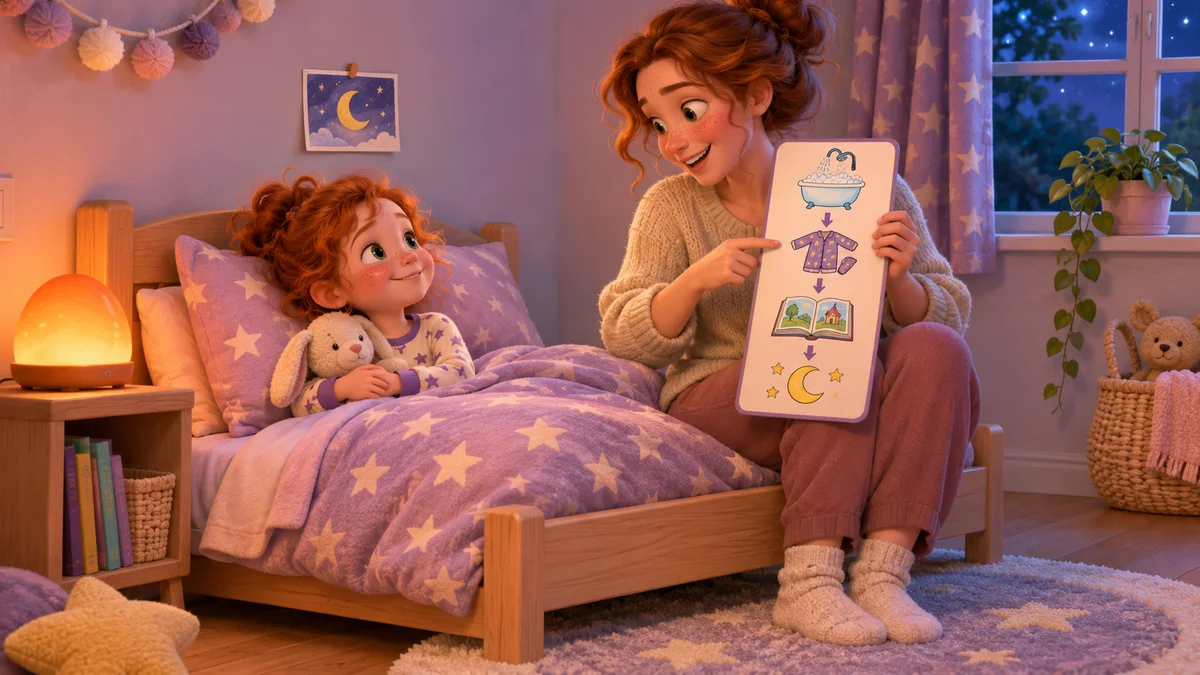
At 3, put the routine on the bedroom wall: five or six pictures (bath, pyjamas, teeth, potty, story, bed) that your child points to as you go. It's no longer you saying "it's time," it's the chart. Here's an example for a 7:15 pm bedtime.
- 6:55 pm
The five-minute warning
"In five minutes, we start the chart." A 3-year-old hates being interrupted mid-play; a heads-up prevents half the meltdowns. Show them the first picture on the chart and let them finish their block tower.
- 7:00 pm
Bath or quick wash
A ten-minute bath with a timer, or face and hands on no-bath nights. Let them wash their own tummy with their washcloth: at 3, "all by myself" is a powerful motivator.
- 7:05 pm
Pyjamas and potty
Pyjamas they pull on almost by themselves (you help with the head). Then one last trip to the potty, even if they say they don't need to. If night-time dryness isn't there yet, this is when the training pants go on, without comment.
- 7:08 pm
Teeth and the glass of water
They brush first, you go over it after. Then a few sips of water, and the cup goes on the nightstand: "It's right there if you're thirsty." That defuses the number-one reason for getting up.
- 7:10 pm
Two stories, then (almost) dark
Two books chosen in advance, read in bed. Then the night light goes on, the big light goes off, cuddle, the nightly words, and you leave with the door ajar. If they get up, back to bed, no words.
Reading to a 3-year-old
At 3, your child can follow a real story: a character, a small problem, a solution. Picture books of 20 to 30 pages with one or two sentences per page are ideal. They'll interrupt to ask "why?" ten times; answer briefly and get back to the text. They also love stories that mirror their life: a child afraid of the dark, sleeping in a big bed, going to daycare. It gives them words for what they're living.
Two books, picked by the child before teeth brushing, read in bed, ten minutes total. Take turns between parents when you can: each reads differently, and that's a good thing. Let them turn the pages and "read" the page they know by heart. Skip the exciting ones right before lights out; save the dragon story for Saturday afternoon. And no screens in the bedroom, ever, even for "just one little video."
Questions parents ask
My 3-year-old won't sleep alone
Very common with the move to a big bed or the arrival of fears. Rather than jumping from "Dad stays" to "Dad leaves," back out in stages: sitting on the bed for three nights, then on a chair beside it, then near the door, then in the hallway. Each stage lasts two or three nights. Keep the night light, the comfort object, the door ajar. It often takes two weeks, and it's normal to slide back when they're sick or after a trip.
Does a 3-year-old still need a diaper at night?
Often yes, and it isn't a delay. Night-time dryness depends on a hormone and bladder maturity, not willpower. Many children are dry by day at 3 and dry at night only around 4 or 5. The sign it's time: a dry diaper on waking several mornings in a row. Until then, training pants, a last potty trip before bed, and no comments about wet nights. If it still isn't there at 6 or 7, talk to your family doctor.
What night light should I choose for a 3-year-old?
A dim, warm-coloured light (amber, orange or red), placed low and away from the face. White or bluish lights interfere with sleep. Skip the ones that project moving stars or play music: fun for five minutes, they keep the child awake. The best test: if you can read a book by it, it's too bright. A small plug-in night light for a few dollars does the job just fine.
Contes de Lune
And where does the card fit in?
At 3, your child recognizes their name on the envelope, and that changes everything: the Contes de Lune postcard, which arrives by mail every week in their name, is theirs. They find their imaginary friend in the picture and ask for "my card" as the last story on the chart. It's short, always the same length, and it ends well: exactly what you want right before the big light goes off.
The last step of the routine, by mail
At Contes de Lune, your child receives an illustrated card in their name every week, with a new chapter of a story where they're the hero, with their imaginary friend. Their first story is free, to read on screen.
Create their first story for freeNo credit card · then, if you love the adventure: the cards by mail for $14.99/month, delivery included in Canada.