How many hours of sleep at this age
11 to 14 hours a day, naps included
That's the range the Canadian Paediatric Society gives for children aged 1 to 2. Every child is different: some do fine on 11 hours, others need the full 14, and both are normal.
Typical struggles, and what to do
They only fall asleep in your arms or while feeding
Léa dozes off on the bottle, you lower her into the crib ever so gently… and her eyes pop open. It isn't a tantrum: she fell asleep with you there and she's looking for you when she stirs. The goal is to put her down drowsy but awake so she learns to finish the job herself. Start with the morning nap, which is easier. Stay beside the crib the first week with a hand on her back, then step back a little further each night. She'll protest for a few minutes at first; that's normal and it usually settles within a week.
Night wakings are back
Your child was sleeping through, and for two weeks now they wake at 2:00 am crying. At 1, the causes are usually simple: a tooth coming in, a cold, or the learning-to-walk project that keeps their brain busy even at night. Keep your visits short and boring: lights off, low voice, no play, no getting out of the crib if you can help it. Check the diaper and the temperature, hand back the comfort object and leave. If the wakings last more than a few weeks or come with a fever, talk to your family doctor or pharmacist.
Two naps, one nap… or no nap at all
Between 12 and 18 months, most children drop from two naps to one. The sign: the morning nap keeps getting later, the afternoon nap gets skipped, and supper turns into a meltdown. During the transition, push the morning nap 15 minutes later every two or three days until it lands after lunch. On days when everything falls apart, move bedtime half an hour earlier rather than forcing a second nap at 4:00 pm. It usually takes two or three weeks to settle.
A 20-minute routine that holds up
At 1, a 15- to 20-minute routine is plenty. What matters isn't the length, it's that the steps always come in the same order, every night, even at Grandma's. Here's an example for a 7:00 pm bedtime.
- 6:40 pm
Bath (or a warm washcloth)
No need for a bath every night. On no-bath nights, a warm washcloth on the face and hands does the same job: it's the signal that the day is winding down. Keep the water warm and the play calm, no big splashing.
- 6:45 pm
Pyjamas and a fresh diaper
In the bedroom, lights dimmed. Name what you're doing: "Blue pyjamas. One arm, the other arm." At this age, your calm voice matters as much as the steps. An overnight diaper with extra absorbency prevents a lot of wakings.
- 6:48 pm
Bottle or nursing
Milk comes before brushing teeth, never after. Give it sitting in the rocking chair, lights low, no screens. Try to finish before they fall fully asleep: if they start nodding off, gently take the bottle away and move on to the next step.
- 6:53 pm
Brushing teeth
A soft toothbrush, a grain-of-rice amount of toothpaste, twenty seconds while you sing a little song. At 1, it's more of a game than real brushing, and that's fine: the habit starts now, the technique comes later.
- 6:55 pm
A board book, then lights out
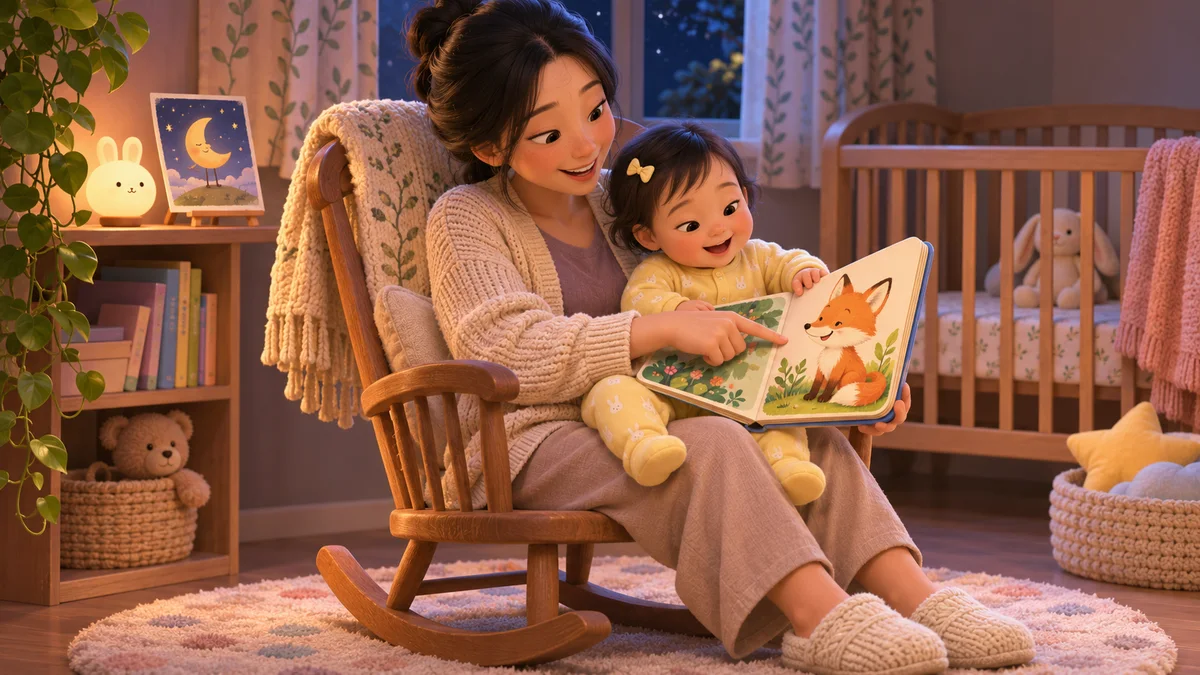
Sitting together, one board book. Point at the pictures: "The cat. The ball." Then the comfort object in their arms, a cuddle, the same words every night ("Good night, see you in the morning"), into the crib, lights out, and you leave.
Reading to a 1-year-old
At 1, you're not really reading a story, you're looking at pictures together. Choose board books with one big picture per page and very little text: animals, things around the house, baby faces. Your child will point, flip pages backwards, chew the corner. All of that counts as reading. Name whatever they point at, make the cow sound, wait for them to react. Two or three minutes per book is already plenty.
Keep the same bedtime book for several weeks. Repetition is reassuring: your child knows what's coming on the next page, and that predictability helps them let go. Whoever is doing bedtime reads, no screens in the room, in a low, slow voice. If Noah wants to shut the book after two pages, that's fine: the routine carries on, there's no negotiating, you move to the cuddle.
Questions parents ask
My 1-year-old wakes up every night, is that normal?
Yes, especially around 12 months: teeth, walking, separation. What helps most is consistency. Same routine, same time, same response at night (short, calm, no lights). If your child falls asleep on their own at bedtime, they'll find it easier to settle themselves at 2:00 am. If the wakings come with a fever, unusual crying or last more than a month, mention it to your family doctor.
What time should a 1-year-old go to bed?
Between 6:30 pm and 7:30 pm for most children, depending on wake-up time and the nap. Count backwards: if they're up at 6:30 am and sleep 11 hours at night, bedtime is around 7:30 pm. During the switch to one nap, don't be afraid to go earlier. A child rubbing their eyes, yawning or getting cranky at supper is ready, even if it's only 6:15 pm.
Does a 1-year-old need a comfort object?
It isn't required, but it's often a big help. A small stuffed animal or a light blanket, always the same one, waiting in the crib every night, becomes an anchor when you're not there. Pick something small, washable and easy to buy a spare of. Introduce it during the routine's cuddle, not only when tears start, so it gets linked to calm rather than distress.
Contes de Lune
And where does the card fit in?
At 1, a Contes de Lune postcard is mostly a lovely picture to look at together. It arrives by mail every week, in your child's name: you open it with them, point at the little hero who looks like them, name the fox, the moon, the hat. They'll follow the story later; for now, what counts is the ritual of the little card you look at before the cuddle.
The last step of the routine, by mail
At Contes de Lune, your child receives an illustrated card in their name every week, with a new chapter of a story where they're the hero, with their imaginary friend. Their first story is free, to read on screen.
Create their first story for freeNo credit card · then, if you love the adventure: the cards by mail for $14.99/month, delivery included in Canada.