How many hours of sleep at this age
11 to 14 hours a day, naps included
That's the range the Canadian Paediatric Society gives for ages 1 to 2. Every child is different: your neighbour's kid sleeps 13 hours, yours sleeps 11 and wakes up bright-eyed, and that's fine.
Typical struggles, and what to do
"No!" at every step of the routine
Emma refuses the pyjamas, runs off giggling when you pull out the toothbrush, screams when you turn off the light. At 2, you don't win by arguing. You win with limited choices: "These pyjamas or those ones?", "You brush first, or Dad does?", "One book on the bed or in the chair?" Two options, both fine with you. She feels like she's deciding; you keep the course. And when she refuses both, choose for her, calmly, without a speech: "OK, I pick the blue one." The routine moves on regardless.
The nap that wrecks bedtime
Some days the daycare nap stretches to 3:30 pm and the 7:00 pm bedtime turns into an hour-long battle. Other days there's no nap at all and supper ends in tears. At 2, most children still need a 1- to 2-hour nap, but it should end before 3:00 pm. If your child fights bedtime, ask the educator to wake them a bit earlier. On no-nap days, move bedtime 30 to 45 minutes earlier. Don't drop the nap altogether though: before age 3, that's rarely the answer.
Night terror or nightmare?
Around 11:00 pm your child screams, eyes wide open, doesn't recognize you and pushes you away. The next morning, they remember nothing. That's a night terror: rare, alarming, but not dangerous. It happens in the first hours of sleep, often when the child is overtired. Don't wake them; stay close so they don't hurt themselves and wait for it to pass. A nightmare is different: later in the night, the child wakes up, cries and wants a hug. Then, comfort them. If night terrors come back several times a week, mention it to your family doctor.
A 20-minute routine that holds up
At 2, 20 minutes is the right length: enough to wind down, not enough to drag on. Announce each step before you do it ("After the bath, it's pyjamas"): a 2-year-old accepts what they see coming far more easily. Here's an example for a 7:00 pm bedtime.
- 6:40 pm
The end-of-day signal
Toys put away together (two or three, not the whole room), curtains closed, living-room lights dimmed. Say the same sentence every night: "Bedtime is starting." The body learns to recognize that signal.
- 6:43 pm
Short bath or washcloth
Five minutes in the tub with one quiet toy, then out when the timer rings, not when the tears start. The timer decides, not you: it avoids a negotiation. On rushed nights, a washcloth and clean hands will do.
- 6:50 pm
Pyjamas, their pick
Two pairs of pyjamas on the bed: "The one with stars or the one with trucks?" Let them pull on one leg themselves, even if it takes longer. Overnight diaper, bedroom light dimmed.
- 6:53 pm
Teeth, then a small cup of water
Evening milk, if there still is one, comes first. You brush first, then "your turn!" so they finish. A small cup of water afterwards, and that's it for drinks: say so clearly to head off the 7:15 pm "I'm thirsty."
- 6:56 pm
One book, the comfort object, lights out
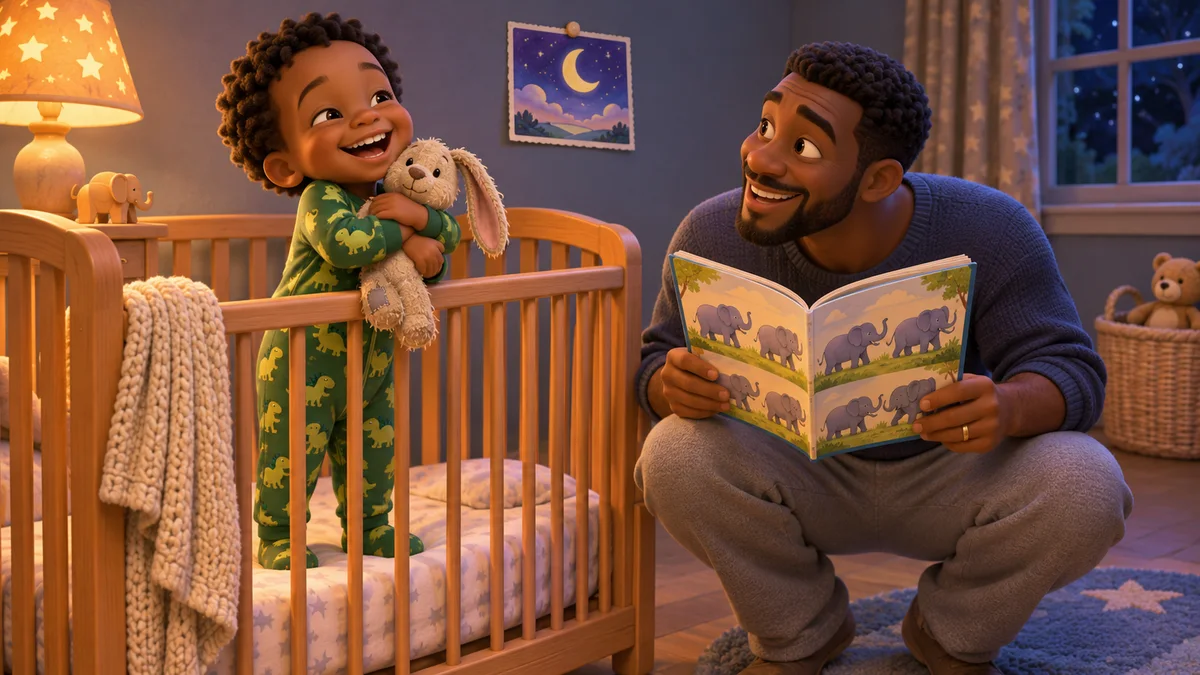
Sitting in the crib or the rocking chair, one book they choose out of two. Then the comfort object, a kiss, the nightly words ("Good night, I love you, see you tomorrow"), lights out, door ajar if it reassures them, and you leave.
Reading to a 2-year-old
At 2, your child wants the same book. Again. And again. It's tiring for you, but it's exactly what they need: they know what's coming, they anticipate it, they finish your sentences. Pick short books with a repeated line ("And the little rabbit said…") and let them fill it in. Routine stories (a bear who takes a bath, brushes their teeth and goes to bed) work very well: they see themselves in it.
One book at bedtime, chosen from two you offer. Leave the bookshelf open and you'll get ten books and an overexcited child. Read slowly, with little questions ("Where's the cat?"), but don't turn reading into a quiz. Five minutes is enough. When the parent reading isn't the usual one, it's normal for your child to demand the other: hold firm, kindly, and keep going with the story.
Questions parents ask
My 2-year-old refuses to go to bed, what should I do?
First check the timing and the nap: a child put to bed too early or who slept until 4:00 pm simply isn't tired. Then tighten the routine: same order, same length, limited choices at each step so they feel they're deciding something. Announce the end before it comes ("one more page, then bed"). Stay calm and repeat the same sentence rather than explaining. Refusals often last two or three weeks, then fade once the child sees it changes nothing.
When should we move from the crib to a big bed?
No rush. As long as your child isn't climbing out and isn't asking for a big bed, the crib remains the best spot: it clearly marks the sleep space and prevents trips down the hallway. Most children switch between 2 and a half and 3 and a half. If a baby is on the way and you need the crib, make the change at least two months before the birth so your older one doesn't link the two events.
My 2-year-old wakes up screaming at night, is it a night terror?
If it happens in the first two or three hours of sleep, their eyes are open but they don't recognize you, and they remember nothing in the morning, it's probably a night terror. They're more common when a child is short on sleep: move bedtime 30 minutes earlier for a week, which often does the trick. If they wake later, cry and reach for you, it's a nightmare: a hug, a few soft words, and back to bed. If in doubt or if it keeps happening, talk to your family doctor.
Contes de Lune
And where does the card fit in?
At 2, the Contes de Lune postcard becomes a small weekly date. It arrives by mail, in your child's name, and you open it together. You show them the picture, name the little hero ("that's you!") and their imaginary friend, and read the few lines out loud. The same card can come back three nights in a row: at this age, repetition is exactly what reassures.
The last step of the routine, by mail
At Contes de Lune, your child receives an illustrated card in their name every week, with a new chapter of a story where they're the hero, with their imaginary friend. Their first story is free, to read on screen.
Create their first story for freeNo credit card · then, if you love the adventure: the cards by mail for $14.99/month, delivery included in Canada.